Metadata and Keywords explained, sort of…
Do you feel your eyes glazing over and your ears muffling when Metadata and Keywords enter the picture? I do. Excuse me while I rinse my eyes and clean my ears to even write this article.
I’m back and determined to conquer the two most dreaded words in my world of publishing fun and inspirational books. Are you with me?
First and foremost, there’s attitude adjustment. They’re just words, for crying out loud. Scribbles on paper. Are they really bigger than us?
No! They are not!
Think of metadata and keywords as the magical spells that guide readers. These are the two elements that lead readers to your books in a gargantuan digital library.
But you must craft them thoughtfully. With the seeker in mind.
Choose relevant keywords to make your book discoverable in our ginormous digital jungle. Remember, you want to be the one shiny object that catches the reader’s eye amidst the sea of options.
How do you become the shiny object?
Enter metadata, keywords, and search engines.
It’s search engines like Google, Bing, Duck-Duck, etc. that dig deep to locate and present readers with on-point books they are seeking. The trick is to shrink the list.
For instance… As a reader, I type ‘Cozy Mystery with Cats’ into the search engine. I get a list of a mere 6,790,000 entries that the writer has included ‘cozy’ ‘mystery’ and ‘cats’ in their keywords when they uploaded the book. Ugh!
Oh, the joy of options that search engines give…
But don’t let that deter you… You have a tidbit of control .
Here’s how.
When I type ‘Alexie Linn’ into a search engine I get a cool 1,430,000 results for this puny little writer. Really? And I thought I was invisible… And therein lies the problem.
Cyberspace is not your corner store. It’s aiming to please over 8 billion seekers of information 24/7. How does cyberspace know what, exactly, is one reader looking for? By sorting through gazillions of metadata and keywords provided by publishers. And algorithms.
What does this mean to the indie publisher?
It means that it’s totally up to the publisher to fork out the metadata and keywords. Search engines then yank documents (books and posts) containing these words out of cyberspace and offer them to the seeker.
To simplify…
Metadata is simply a plural noun that means ‘computing information that is held as a description of stored data.’ It’s information about information. A library catalog is metadata because it describes publications. My web address, alexielinnauthor.com, is metadata because it holds the key that describes Alexie Linn’s publications.
Clear as mud? Maybe not so much anymore. According to Ingram Spark, ‘Simply put, your book metadata is any data that describes your book—including title, subtitle, price, publication date, ISBN, and any …’ Metadata is a given. Not a guessing game.
Got it. Metadata is required for any uploaded book. That’s logical.
But what about keywords? And hashtags? When will it end?
Keywords are for Search Engine Optimization (SEO). Period. They are a significant word or phrase that describes a document. Cat is a broad keyword. My search engine pulled up over 6 million cozies with cats. But when I added Calico Cat, it narrowed my search to only 810,000 books. It zeroed in on the choices – bypassing a bunch!
So, if my book is about a calico cat, I should make calico cat a keyword or longer phrase to get my story 6 million times closer to being found. ‘Male calico cats’ cut the options to 756,000. About another 60,000 entries closer to discovery.
Do you see what’s happening? Keywords are what sets your book apart from the hordes. Make your keywords be the only brunette in a sea of blondes. Assuming the reader is looking for a brunette in their search…
Hashtags are the same, but completely different in their use. Not for this post.
If these two words are still making your brain ooze, I have a couple of key recommendations. One is ‘Amazon Keywords for Books’ by Dale Roberts. The book dives deeper but doesn’t drown you. I also own and am affiliated with Dave Chesson’s Publisher Rocket. Publisher Rocket is an shockingly quick and easy research tool for keywords, competition, categories and more. I have found that both of these tools are paramount to success and well worth the investment.
However, if your wallet is currently financially embarrassed, type ‘keywords for authors’ into any search engine. You will find oodles and oodles of free to read posts written on the topic.
But enough said for now about keywords and metadata. Let’s move on to this week’s much more exciting featured offer for only you valued readers of my little newsletter.
WooHoo! Book 20 of the Sally the Loner series has launched and is available today! The eBook is only 99¢ if you grab it through the button below.
Here’s the cover…
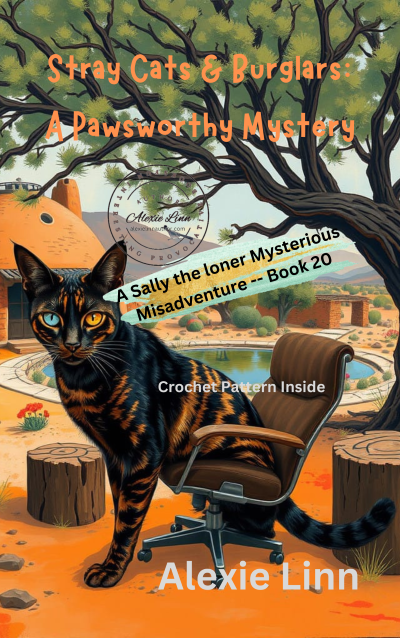
What would you do if a pushy cat came scratching at your door? A rare male calico cat. Would you shoo him away? Invite him in? Or let him take over the place while you searched for his caregiver?
Better yet. What would Sally do?
Join Sally and Rodney on this wild ride of a rambunctious, bossy, cuddly stray cat that seems to know more than he’s saying. And is the source of chaotic upheaval on Sally’s compound; including sending Sally to jail.
And while we’re on the subject of featured deals…
You might also like…


 Alexie Linn, the Author, and Homespun Rebel