🥖 Sourdough in the Presidential Kitchens: A Surprisingly Yeasty History (and What It Teaches Us About Storytelling, Survival, and the Three Books You’ll Love)

Man preparing sourdough starter in rustic kitchen at dusk

Warning! The following statements are unproven, but make a good story, anyway. A bibliography is included to get you started on your journey to discovering the truth about sourdough in Presidential kitchens.

If you’ve ever stood in your kitchen staring down a jar of sourdough starter that looks like it’s plotting a coup, you’ve already experienced a tiny slice of presidential life. Because here’s the truth no one talks about: sourdough has been quietly shaping American presidencies for more than a century.

Not in the dramatic, headline‑grabbing way — no president has ever declared a national emergency over a sluggish starter (though some came close). But tucked behind the swinging doors of the White House kitchens, sourdough has risen, fallen, bubbled, sulked, and occasionally exploded its way through administrations like a carb‑forward advisor with strong opinions.

And honestly? It makes perfect sense. Sourdough is stubborn. Sourdough is unpredictable. Sourdough thrives under pressure. Sourdough is basically a politician made of flour.

But more importantly, sourdough is a story engine, which is why it threads so beautifully through The Skinny on Sourdough, Sally the Loner Meets the Sourdough Kid, and The Sourdough Bakeoff. Each book taps into the same themes that have made sourdough a quiet staple in the presidential kitchens: resilience, reinvention, community, chaos, and the occasional kitchen disaster that becomes a national metaphor.

So let’s take a tour — a warm, flour‑dusted walk through presidential history, cozy fiction, and the strange ways sourdough keeps showing up exactly where we need it.

🥨 The Early Presidents: When Sourdough Was a Survival Strategy

Long before the White House had a pastry chef, sourdough was the backbone of frontier cooking. Presidents like Washington and Jefferson weren’t kneading dough in the Oval Office, but their kitchens relied on wild yeast because commercial yeast didn’t exist yet.

Sourdough was the original “American starter,” a living thing that traveled in wagons, sat by hearths, and survived winters that would make modern bakers cry into their bannetons.

This era mirrors the tone of The Skinny on Sourdough, where the starter isn’t just an ingredient — it’s a companion, a teacher, a slightly dramatic pet. The book’s playful breakdown of sourdough science echoes the early American cooks who learned by instinct, smell, and the occasional loaf that came out shaped like a political scandal.

Early sourdough was rustic, practical, and deeply personal. Just like the stories we tell about our beginnings.

🍞 Lincoln’s Era: Sourdough as Comfort Food in Hard Times

During the Civil War, sourdough traveled with soldiers, nurses, and families trying to make do with limited supplies. It was cheap, filling, and forgiving — a loaf that didn’t judge you for being exhausted.

This is where sourdough becomes symbolic. It’s the “we’ll get through this” bread. The “we’re doing our best” bread. The “this is not pretty but it’s honest” bread.

That’s the same emotional backbone of Sally the Loner Meets the Sourdough Kid. Sally doesn’t bake because she loves it; she bakes because life hands her a starter and says, “Deal with it.” Her sourdough moments are gritty, stubborn, and unexpectedly tender — the kind of scenes that would’ve fit right into a wartime kitchen where people were simply trying to feed each other and stay human.

Sourdough has always been the bread of resilience. Sally is the character of resilience. It’s a natural pairing.

🥖 The 20th Century: When Sourdough Became a White House Quiet Favorite

By the time we reach the Roosevelts, sourdough has become a comfort food for presidents who needed grounding. Eleanor Roosevelt famously championed simple, frugal meals — not because she lacked taste, but because she believed in practicality and humility.

Sourdough fit perfectly.

It was democratic. It was economical. It was reliable.

And it was one of the few foods that tasted the same whether you were a president or a farmer.

This era feels like The Sourdough Bakeoff, where ordinary people rise (pun intended) to extraordinary moments. The book’s small‑town bakers, unexpected triumphs, and community‑driven chaos echo the spirit of presidential kitchens that fed staff, guests, and leaders with the same humble loaf.

Sourdough is the great equalizer. It doesn’t care who you are. It only cares if you fed it.

🍞 Modern Presidencies: Sourdough as a Cultural Icon

In recent decades, sourdough has become a symbol of authenticity — the kind of food presidents mention when they want to seem relatable. It’s the “I’m just like you” bread. The “I bake on weekends” bread. The “my starter has a name” bread.

White House chefs have confirmed that sourdough appears regularly on menus, especially during state dinners where American heritage foods are highlighted. It’s served with butter, olive oil, soups, and occasionally as the base for sandwiches that look suspiciously like the ones you make at home.

This modern sourdough era mirrors The Skinny on Sourdoughs playful tone, Sally the Loner’s reluctant domesticity, and The Sourdough Bakeoff’s celebration of community. All three books tap into the idea that sourdough is more than food — it’s identity, nostalgia, and a tiny rebellion against the fast‑paced world.

🥖 What Presidential Sourdough Teaches Us About this Month’s Three Featured Books

1. Sourdough is a character, not an ingredient.

In The Skinny on Sourdough, the starter has moods, opinions, and a dramatic flair that would fit right into a presidential biography.

2. Sourdough is a metaphor for growth.

Sally’s journey mirrors the starter’s: neglected, revived, unpredictable, and ultimately capable of rising.

3. Sourdough builds community.

The Sourdough Bakeoff thrives on the idea that bread brings people together — just like it has in the White House for generations.

4. Sourdough is messy, stubborn, and honest.

Presidential kitchens know this. These books know this. Readers feel this.

Sourdough is the perfect narrative thread because it’s alive. It demands attention. It refuses to be rushed. It teaches patience, humility, and the art of laughing at yourself when your loaf comes out shaped like a political scandal.

🍞 A Fictional Peek Inside the Presidential Kitchen (Because Why Not)

Imagine a White House chef in the early morning hours, staring at a jar of starter that has doubled overnight and is now threatening to breach national security protocols.

He sighs. He tightens the lid. He mutters, “Not today.”

This is exactly the kind of scene Sally would walk into, roll her eyes at, and say, “I’ve escaped jars too. Let it have its moment.”

Or the kind of moment that would kick off The Sourdough Bakeoff, where a visiting dignitary accidentally becomes a judge in a diplomatic bread competition.

Or the kind of anecdote that would appear in The Skinny on Sourdough, tucked between tips about hydration ratios and warnings about starters with attitude problems.

Sourdough belongs in presidential kitchens because it belongs everywhere humans are trying their best.

🥖 Why Sourdough Endures — In History, Fiction, and Your Kitchen

Sourdough is the perfect symbol for American life:

  • It’s built on tradition.
  • It adapts to change.
  • It survives neglect.
  • It thrives under care.
  • It grows stronger when shared.
  • It’s messy, unpredictable, and occasionally brilliant.

Just like the characters in these books. Just like the people who read them. Just like the presidents who quietly relied on sourdough to bring a little comfort to complicated days.

Sourdough is the story of rising again — in kitchens, in communities, in fiction, and in history.

And that’s why it deserves its place in the presidential kitchens and in your creative universe.

BIBLIOGRAPHY — Presidential Sourdough Post

  • Dinner with the President — Alex Prud’homme
  • HISTORY.com — Roosevelt kitchen history
  • Tasting Table — Eleanor Roosevelt’s 7‑cent meals
  • The Telegraph — Roland Mesnier obituary
  • Eating History — Andrew F. Smith
  • Library of Congress — Early Republic foodways

Perfect for readers who love history, humor, and carbs.

Image of sourdough starter with it's own security clearance

And just one more thing…

Have you signed up for The Nifty-News Mashup yet? You can. Right here. Right now. And there’s a little somethin’-somethin’ else in it for you, too. Here’s how…

Join and Follow Alexie Linn on:

TeePublic Shop

 Facebook

Pinterest

Goodreads

 Amazon

Bookbub

Instagram

X

Tik Tok

You Tube Channel

Email

Are You Ready to Rise into August’s Slow Magic?

Loaf of bread transforming into wheat stalks and a golden field

Sourdough at Summer’s Edge — A Month for Slow Magic, Soft Light, and Unruly Sourdough Starter Stories That Rise

The first sign of August wasn’t the weather—it was Sally’s starter staging a kitchen coup. Normally August drifts in quietly, like the moment you realize the evening air has changed — still warm, but with a subtle shift that makes you pause. A softness. A slowing. A whisper that summer is beginning its long, graceful bow.

This is the season of almost‑fall. The season of ripening. The season of “last calls” and “one more adventure” and “let’s savor this while it’s here.”

And this year, August brings with it a theme that feels perfectly aligned with that mood: sourdough — the slow, living, patient companion that teaches you how to move through transitions with curiosity instead of urgency, unless ‘granny’ is outdoing herself over the top of the jar.

But before we step fully into August’s warm‑kitchen glow, it feels right to linger for a moment in July — the month that carried us through frontier skies, lodge intrigue, and northern‑light wonder. July’s stories are still here, still part of the season’s tapestry, still echoing in the background as we move forward.

This isn’t a sales pitch. It’s a gentle reminder that stories, like seasons, deserve to be savored before they slip into memory.

🌲 July’s Stories: The Last Call of High Summer

July was a month of big landscapes and bigger feelings — the kind of stories that smell like campfire smoke and long daylight. As August approaches, these tales feel like postcards from summer’s wilder side.

Alaska: My First Frontier

This story carries the raw, unfiltered energy of stepping into a place that doesn’t bend to your expectations. Alaska is a frontier in every sense — physical, emotional, spiritual. The narrative feels like standing at the edge of something vast and letting it rearrange you. It’s a story about courage, but also about humility. About learning that the land has its own language, and you’re just beginning to understand it.

Aurora Borealis Affair

If July had a soundtrack, it would be the quiet hum of northern lights. This story glows with that same energy — luminous, unpredictable, and a little otherworldly. It’s romance, yes, but also revelation. The kind of tale that reminds you how small you are under a sky that dances. How love sometimes arrives like a shimmer you weren’t expecting.

Mistresses of Mormon Lake Lodge

This one feels like sitting in a wooden chair on a lodge porch, listening to women who’ve seen more than they say. It’s gossip, but it’s also legacy. Secrets, but also solidarity. A story about the quiet power of community — the kind that forms in kitchens, hallways, and late‑night conversations when the world outside goes still.

These July stories are the final bright notes of summer’s high season. They’re still here, still part of the moment, still waiting for anyone who wants to linger in July’s glow a little longer.

Seasonal Vibes Sale pin
Sale ends July 31 at midnight

But August is calling — and it’s calling with the scent of warm bread.

🍂 August’s Mood: The Season of Slow Magic

August is a hinge month — the gentle turning of the year. It’s not the exuberance of June or the full‑tilt adventure of July. It’s quieter. More reflective. More about tending than chasing.

It’s the month where gardens peak, where sunsets deepen, where routines soften, and where we begin to crave stories with warmth and substance.

Which is why sourdough feels like the perfect August companion.

Sourdough is a practice. A ritual. A reminder that transformation is slow, patient, and often invisible until suddenly — it rises.

This month’s featured stories lean into that energy. They’re not about perfection. They’re about process. They’re about the messy, funny, heartfelt moments that happen when you try to create something meaningful in a world that rarely slows down.

🍞 August Story #1: The Skinny on Sourdough

This story is the doorway into August’s theme — a gentle, humorous introduction to the world of wild yeast and the people who love it (or try to). It’s part kitchen memoir, part life lesson, part “why is this dough behaving like a toddler.”

It’s about learning to trust the rise. Learning to let go of control. Learning that sometimes the starter teaches you more than the recipe.

It’s the perfect beginning for a month that asks us to slow down and pay attention.

🍞 August Story #2: The Sourdough Bakeoff

If July was about frontier adventure, August is about small‑town chaos — the kind that happens when pride, pastry, and personality collide. This story is warm, funny, and filled with characters who are trying their best, even when their best involves questionable baking strategies and emotional arcs disguised as bread competitions.

It’s a story about rising to the occasion, even when the occasion is messy. About finding confidence in unexpected places. About discovering that community often forms in the middle of shared disasters.

It’s August’s reminder that growth doesn’t have to be quiet — sometimes it’s loud, chaotic, and covered in flour.

🍞 August Story #3: Sally Meets the Sourdough Kid

Sally the Loner returns, still prickly, still independent, still convinced she doesn’t need anyone. Which is exactly why August hands her a kid with a sourdough obsession and a knack for trouble.

This story is tender in the way late summer is tender — warm, but with a hint of change. It’s about reluctant mentorship, unexpected connection, and the way sourdough becomes a bridge between people who didn’t know they were looking for each other.

It’s the emotional heart of August’s lineup — a story about softening, even when you don’t want to.

🌾 Sourdough as a Seasonal Metaphor

Sourdough isn’t just bread. It’s a rhythm.

You feed it. You wait. You watch. You learn. You try again if you missed the memo that the ‘dirty socks smell is normal’ forewarned you about.

It’s the perfect metaphor for August — a month that asks us to slow down, to tend what matters, to let things rise in their own time.

July was about big skies and bold stories. August is about the quiet work of becoming.

These sourdough stories aren’t about perfection. They’re about process. They’re about the beauty of trying. They’re about the way something small and humble can become something nourishing.

They’re about the season we’re in — the season of slow magic.

🌻 A Late‑Summer Reading Ritual

If you want to fully embrace August’s mood, here’s a gentle ritual to carry you through:

  • Read outside in the warm evenings when the light turns honey‑gold.
  • Pair your reading with something comforting — tea, lemonade, or a slice of bread if you’re feeling whimsical.
  • Let the stories rise slowly.
  • Notice the parallels between sourdough and your own life.
  • Allow yourself to soften into the season.

August isn’t a month to rush. It’s a month to savor (unless you’re caught up in a heat dome during monsoon season. I’m not savoring that. Are you?).

📚 The Seasonal Bridge: July → August

Together, July’s frontier tales and August’s sourdough stories create a beautiful transition — from wild adventure to warm reflection, from big landscapes to intimate kitchens, from high summer to almost‑fall.

July gave us the sky. August gives us the hearth.

Both matter. Both belong. Both shape the season.

🌅 Closing: The Rise Before Fall

August is the last warm breath before autumn. The final stretch of long days. The moment where everything feels suspended — not ending, not beginning, just quietly transforming.

Sourdough fits this moment perfectly.

It rises slowly. It teaches patience. It reminds us that change is happening even when we can’t see it.

So, here’s to August — the month of soft light, slow magic, and stories that rise.

Here’s to July — still lingering, still glowing, still part of the season’s story.

And here’s to you — moving through summer’s last call with curiosity, warmth, and a stack of stories that feel like home.

And to get the ball rolling, here’s a tiny story to set the stage for what’s to come…

🥖 Sally the Loner’s Late‑Summer Memory: The Day the Starter Snapped

Sally wasn’t trying to remember anything that day. She was trying to mind her business — which, in her opinion, was the highest form of self‑care.

It was late summer, the kind of heat that makes the air wobble. Sally had agreed (against her better judgment) to watch someone’s sourdough starter while they were “finding themselves” in Sedona. She didn’t ask for details. She didn’t want details. She just wanted the jar to sit quietly on her counter and not cause trouble.

But trouble, as usual, had other plans.

On day three, the starter rose like it had been personally offended. It pushed the lid off with the confidence of a teenager who’d just discovered sarcasm. Sally stared at it, unimpressed.

“Absolutely not,” she said to the jar of starter they’d named Lovey.

Lovey did not care.

She bubbled over the edge, oozing down the sides like she was trying to escape the life she had been assigned. Sally recognized the energy immediately. She’d felt it herself at fourteen, sixteen, twenty‑nine, and last Tuesday.

She cleaned the counter, muttering about boundaries. She fed the starter, muttering about responsibility. She put the lid back on, muttering about people who go to Sedona and leave their problems behind.

But then something unexpected happened.

Lovey rose again — softer this time, slower, like she was trying to apologize without actually saying the words. Sally sighed. She knew that feeling too.

Sometimes you overflow because you’re overwhelmed. Sometimes you rise because you’re ready. Sometimes you make a mess because you don’t know what else to do.

She sat down at the kitchen table, the late‑summer light turning everything gold. The starter burped gently, as if to say, Look, I’m trying.

Sally nodded. “Same.”

It wasn’t a big moment. It wasn’t a dramatic revelation. It was just one of those quiet, late‑August memories that sticks — the kind that reminds you that everything, even sourdough, is just doing its best to become something.

And Sally, despite her reputation, let herself soften. Just a little. Just enough.

~ fin ~

Hug your sourdough day image

And just one more thing…

Have you signed up for The Nifty-News Mashup yet? You can. Right here. Right now. And there’s a little somethin’-somethin’ else in it for you, too. Here’s how…

Join and Follow Alexie Linn on:

TeePublic Shop

 Facebook

Pinterest

Goodreads

 Amazon

Bookbub

Instagram

X

Tik Tok

You Tube Channel

Email

A Passel of Puzzling People

Cabin with lit windows by a river surrounded by pine trees and snowy mountains at sunset

Looking for a trio of unforgettable characters who blend mystery, humor, and desert‑wild adventure? This month’s featured stories introduce three headliners—Alexie Linn, Joan Freed, and Sally the Loner—each with their own brand of chaos. From off‑grid living in the Sonoran Desert to ghost‑driven mysteries at Mormon Lake to a rebel life coach trekking from Arizona to the Arctic Circle, these women deliver intrigue, heart, and a dash of supernatural mischief. If you love character‑driven storytelling, cozy mysteries, or memoirs with grit, this month’s lineup is your new favorite rabbit hole.

A Passel of Puzzling People

Three headliners. Three wildly different lives. One author who somehow wrangles them all into stories that feel both impossible and absolutely true.

Every month brings a new batch of characters into the spotlight, but this month’s trio is especially puzzling—in the best possible way. They’re the kind of people who wander into your life, rearrange the furniture, leave you with more questions than answers, and somehow make you grateful for the chaos.

At the center of this passel of puzzling people is Alexie Linn, the author who writes them, survives them, and occasionally swears they write her instead.

But before we get to the rebel life coach, the six‑gun sidekick, the desert aunt, and the ghosts who refuse to mind their own business, let’s start with the woman who began it all.

🌲 Alexie Linn: The Storyteller Who Didn’t Mean to Become an Author

Alexie Linn’s first audience wasn’t human. It was feline.

Her earliest memory of storytelling is lying in a hammock strung between two cherry trees, a handful of kittens sprawled across her lap like tiny, purring critics. She whispered stories to them—tales about mountains, mischief, and imaginary adventures—and the kittens listened with the kind of rapt attention only cats and small children can manage.

But she didn’t call herself an author. Not yet.

That didn’t happen until The Gold Prospector bought and published Jack Post’s Mountain of Gold, a true story that proved her words could travel farther than her backyard. Even then, she didn’t leap into the author life. She tiptoed. She tested. She waited.

It wasn’t until she became an empty‑nester widow—facing quiet mornings, long evenings, and a life that suddenly felt too still—that she got serious about writing books that help people move forward after loss. Not with denial. Not with forced optimism. But with a genuinely happy heart.

Her characters began arriving like unexpected guests. Some knocked politely. Others barged in. And one of them—Joan Freed, the rebel life coach—refused to leave.

But while Alexie was waiting to become a real author, she did some beguiling living.

Alexie’s newest memoir, Alaska: My First Frontier, is scheduled for release on July 31. That date isn’t random. It’s daughter #2’s birthday—more than fifty years ago—and readers of True Tales from the Old Cabin will recognize her antics immediately. Alaska was the frontier Alexie didn’t know she needed, and the memoir captures the years she lived while waiting to become “a real author,” even though she already was one.

Book cover of Alaska, My First Frontier

Alexie likes her coffee black, her apple cake slightly burnt, and her solitude uninterrupted. Her sidekick is whoever steps up at the moment—neighbors, strangers, readers, or the occasional ghost who refuses to stay politely in the background.

She knows she’s hit the target when a reader says, “A fun, provocative, and interesting story.” And this month, she’s offering three.

🔥 Joan Freed: The Rebel Life Coach Who Coaches Herself Into Trouble

If Alexie is the storyteller, Joan Freed is the wildfire.

Joan didn’t just rebel against societal norms—she rejected them with gusto. Fixed offices? No thank you. High heels? Absolutely not. Business suits? Only if they come with pockets big enough for snacks, a compass, and a spare flashlight.

She believes people need help where they are, even if “where they are” happens to be a tent, a trailhead, or the back of a pickup truck. She camps more than she commutes. She hikes more than she networks. And she has coached clients in places most life coaches wouldn’t dare to visit without a liability waiver.

Her sidekick, six‑gun‑totin’ Jenny Crawford, joined the chaos in book five (Elaine the Hoarder). Jenny is the kind of woman who can fix a flat tire, shoot a rattlesnake, and bake a pie without breaking a sweat. Together, Joan and Jenny have survived dust storms, questionable diners, and clients who should probably come with warning labels.

This month’s featured story, The Aurora Borealis Affair, yanks Joan and Jenny from the Sonoran Desert to the Arctic Circle and back again. It’s a tale filled with surprises—some delightful, some dangerous, and one that involves an amnesiac southern belle who somehow ends up crashed in Joan’s bed. She’s discovered after Joan and Jenny return from a hike.

Aurora Borealis Affair Book cover

Joan insists this was not on her itinerary.

She drinks her coffee black, her yogurt straight from the jar, and her nature wild and unfiltered. She is happiest when the wind is loud, the trail is long, and the next mystery is waiting just around the bend.

Click here to grab the free Prequel to the Joan Freed Mystery/Adventure Series.

🌵 Sally the Loner: The Desert Aunt Who Attracts Trouble Like a Magnet

And then there’s Sally the Loner—Joan’s spunky, wise, desert‑dwelling aunt who attracts misadventures the way porch lights attract moths.

Sally lives alone in an off‑grid adobe igloo two miles down the road from niece Joany and half a mile from a quirky community that generates more mysteries than rainfall. Her ghostly mother drops by for tea—despite having died twenty years ago—and Sally accepts this with the same shrug she gives to rattlesnakes and unexpected visitors.

She is the second natural spin‑off from the Joan Freed Series, and she arrived fully formed: stubborn, sharp‑eyed, and absolutely uninterested in living a normal life.

Before marauders tore her home to smithereens one summer, Sally called herself a Sunbird. Every July and August, she escaped the oppressive monsoon season by migrating to Mormon Lake, just south of Flagstaff. She’d been doing it for years—even after retiring from her job at the lodge.

But finding a safe place to park her van grew harder each year. Too many rules. Too many campers. Too many people who didn’t understand the sacred art of minding their own business.

So, she answered a Craigslist ad.

That ad led to The Mysterious Mistresses of Mormon Lake Lodge, book four in her series. The ad—naturally—was placed by three ghosts who needed their murder solved before they could pass on. Sally didn’t want the job, but her ghostly mother had told the ladies Sally would do the job. And who can win an argument with their long‑dead mother?

Mysterious Mistresses of Mormon Lake Lodge Book Cover

Sally wakes at 2 a.m. without an alarm, drinks her coffee black, bakes sourdough that could win awards, and prefers living alone—except when the universe decides otherwise.

Her life is a blend of desert silence, unexpected visitors, ghostly demands, and mysteries that seem to find her whether she’s looking for them or not.

Click here to get the free Prequel to the Sally the Loner Series.

🌟 Why These Three? Why Now?

Because they’re connected—not just by the author who writes them, but by the themes that run through their stories:

  • Resilience
  • Reinvention
  • Mystery
  • Humor in the face of chaos
  • The stubborn belief that life can still surprise you

Alexie writes characters who don’t wait for permission. They wander into trouble. They wander out of it. They make choices that are messy, brave, questionable, and occasionally supernatural.

They remind readers that life is rarely tidy—and that’s exactly what makes it interesting.

🌄 A Month of Mystery, Mischief, and Frontier Spirit

This month’s featured stories highlight three corners of Alexie’s storytelling world:

  • Alaska: My First Frontier — a memoir of becoming, belonging, and surviving the wild.
  • The Aurora Borealis Affair — a rebel life coach adventure that stretches from desert heat to Arctic cold.
  • The Mysterious Mistresses of Mormon Lake Lodge — a ghost‑driven mystery that proves the dead have deadlines too.

Together, they form a tapestry of puzzling people—each one flawed, fascinating, and impossible to forget.

Click the picture to Learn more

Join and Follow us on:

TeePublic Shop

 Facebook

Pinterest

Goodreads

 Amazon

Bookbub

Instagram

X

Tik Tok

You Tube Channel

Email

Digital Safety & Scam Prevention Tips

Locked wooden door glowing green with shadowy claws reaching toward it in a stone chamber
Alexie Linn's Cozy Mystery & Memoir Blog header

Welcome to the Cozy Mystery & Memoir Blog where we talk about stories and storytelling. Writing them, reading them, dissecting them, and most important, loving them. Sign-up for the Nifty-News Mashup at the blue box below.

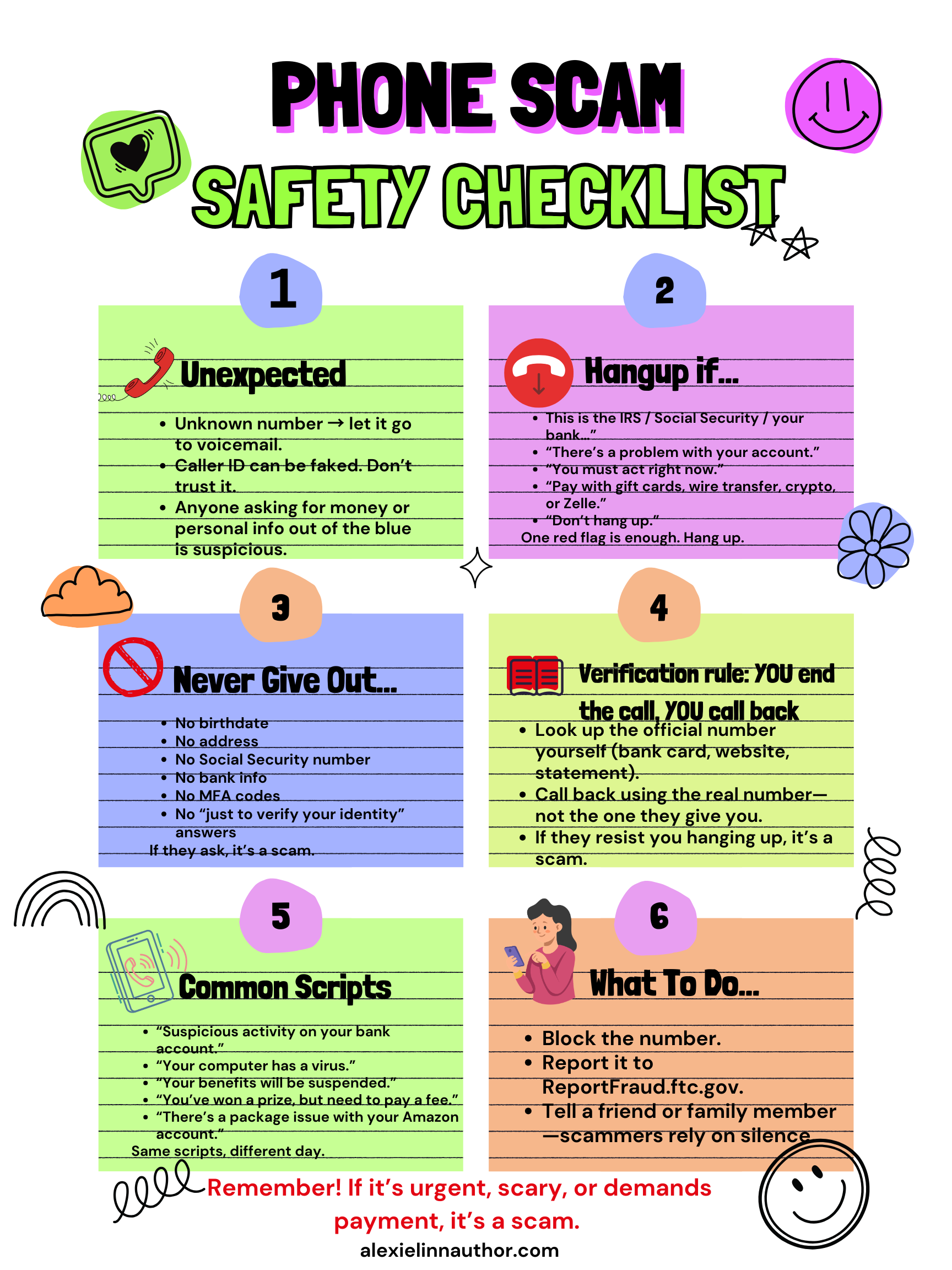
I was on the SCAM Shortlist—How I Put the Kibosh on their $9,000 Con—You Can, Too

The Scam: “I’m calling from the Pinal County Sheriff’s Office…” were the first words I heard when I answered the persistent call from a Restricted phone number. I don’t answer calls from unknown callers. But they kept calling. I answered, concerned that one of my peeps needed me.

I can’t give you the conversation verbatim. The following dialogue is the closest to what I remember.

“This is Officer ____. I’m calling to tell you how to prevent a warrant being issued for your arrest.”

“Arrest?” My stomach clenched. “What have I done that I didn’t know I did?” my mind racing to retrace my past.

“You’re being held in Contempt of Court for not appearing for Jury Duty today and for ????.” (The second offense he named didn’t register)

I hadn’t had a Jury Duty call in a few years. Definitely not recently. “Jury Duty? Why didn’t I know I had Jury Duty? I’ve not received any notification.”

“You received notification on May 5th to appear today (May 12th).”

Me: “I did? How come I don’t know that? I don’t understand.”

“You can prevent arrest by appearing here for a signature verification on the DNR (Did not receive) and DNS (?)”

Me: “Where’s here?”

The session went on for about an hour… me asking questions; he and his Captain Kristopher Nabor, 30115, skirting my questions and telling me I will be arrested when I try to enter the Sheriff’s department unless I first obtain a Binary Trust Certificate and pay the fines.

He gave me two addresses where I could pay the fines and get the certificate. He assured me I would be reimbursed for the fines when I prove I did not know I was to appear (through the signature verification at the Sheriff’s office).

Are you sitting down to see the cost of this scam? The fine for each offense was $4,500! $9,000 total!

When I gasped and said that’s not happening, he said he’d work with me. How much can I pay?

I said, 5-bucks. I can survive without $5.

He was not pleased and mentioned I’d be spending 30-45 days in jail for Contempt of Court if I don’t handle this now. And on he babbled.

I asked for his phone number so I could talk to someone and call him back. He reminded me again of my imminent arrest. No phone number came.

That’s when I told him to do what he has to do and ended the call. My next call was to the Pinal County Sheriff’s office. She said it was a scam and I absolutely did the right thing. No one would be coming for me with an arrest warrant.

The first clue that this was a scam was when the officer mispronounced the name of the county he was calling from. His supervisor mispronounced the name of the street that the Sheriff’s office was on in the tiny town of Stanfield. Both places are very well known.

When neither would answer my specific questions, I really knew it was hokey. I looked up the addresses they gave me to pay the fines and get a *Binary Trust Certificate at. Both were to a Circle K. One advertises a Bitcoin machine available. I can’t imagine that Circle K is involved in this in the slightest.

(*According to Bing: A binary trust certificate typically refers to digital certificates encoded in a binary format, such as DER (Distinguished Encoding Rules). These certificates are used in various security protocols to establish trust between parties.)

I found no Captain Kristopher Nabor (he spelled it for me) within the Pinal County Sheriff’s Department.

Don’t Get Scammed!

First, listen. Then ask questions. Or just hang up!

One sentence to remember

If it’s urgent, scary, or demands payment, it’s a scam.

Because I’m also keenly aware of voice cloning, I told my peeps, “If you get a call that I’ve been kidnapped or am in deep doo-doo using mt own voice, don’t believe it without first checking. It’s probably a scam.

Listen, ask questions, get a number to call them back.”

If it’s urgent, scary, or demands payment, it’s a scam.

Click on the link for a poster size printable Infographic to download and share with all your peeps: Infographic to Print

phone scam infographic
Alexie Linn's Nifty-News Mashup Sign-up page

Join and Follow us on:

 Facebook

Pinterest

Goodreads

 Amazon

Bookbub

Instagram

X

Tik Tok

You Tube Channel Email

What Is a Memoir? Your Cabin Adventure Awaits (And It’s Hilariously Worth Writing)

What is a Memoir? Grandma telling a story to a youngster.

What Is a Memoir— Why Your Story Deserves to Be Told

What is a memoir? Simply put, it’s the bridge between your lived experiences and the readers who desperately need to hear them.

Unlike an autobiography that chronicles every detail of your entire life, a memoir focuses on specific moments, themes, or periods that shaped who you’ve become. Think of it as taking your most transformative experiences—like surviving an Alaskan wilderness with a marriage you didn’t quite choose and a washing machine that apparently wanted to commit murder—and crafting them into a narrative that resonates, entertains, and inspires.

Answering “what is a memoir” means understanding its unique power: your story doesn’t need to be extraordinary by Hollywood standards. It just needs to be authentically yours. Whether you faced down moose with the confidence of a teenager who knew nothing, or learned life lessons from frozen laundry, your experiences contain universal truths wrapped in personal details. That’s the magic readers crave.

The Mystical Mischief of Your Own Story

Consider the opening passage from True Tales From the Old Cabin — “All right, I’ll take you in. But don’t expect me to make it easy.” And then, with a sigh of settling 2×4’s, it did exactly that.”

What is a Memoir? True Tales from the Old Cabin book cover

The cabin itself becomes a character, complete with personality, humor, and lessons delivered without mercy. This transformation of place into presence, of hardship into humor, exemplifies what memoir writing accomplishes at its finest.

Your story contains similar treasures waiting to be unearthed. Perhaps your Alaska was a different kind of wilderness—corporate America, single parenthood, or reinventing yourself after loss. The specific details matter less than the emotional truth you discovered along the way. Consequently, readers don’t connect with perfection; they connect with authentic struggle, unexpected humor, and hard-won wisdom.

Why “Freakishly Fun” Isn’t Just Clever Marketing

The Write Your Freakishly Fun Memoir online, self-paced course doesn’t accidentally include “fun” in its title.

Traditional memoir writing advice often drowns aspiring authors in somber reflection and painful excavation of trauma. While depth matters, joy matters equally. After all, even stories about wringer washers attempting interdimensional kidnapping can—and should—make readers laugh while they learn.

what is a memoir? Woman smiling while editing her memoir

This approach transforms the writing process itself. Instead of dreading each session at your keyboard, you’ll discover the same wonder that appeared between danger and growth in that Frankensteined cabin. The course guides you through shaping your memories into narratives that feel alive, present, and engaging. Therefore, your readers won’t just understand your journey—they’ll feel the soot on their own eyelashes and hear the cabin’s skeptical welcome in their own ears.

From Scattered Snippets to Cohesive Story

Perhaps you’re thinking, “I have stories, but they’re just… fragments.” Perfect. That’s exactly where every memoir begins. Resources like Turn Your Snippets into a Story—Even If You’re Not a Writer Yet exist specifically for this common challenge. You don’t need to arrive with polished prose or a complete narrative arc. You simply need the willingness to start.

What is a memoir? Image of snippets falling into a book.

Similarly, The Family Legacy Workbook helps structure those fragments into meaningful patterns. Think about how “Child Bride in Alaska” weaves together washing machines, Northern Lights, judgmental moose, and personal transformation. These seemingly disparate elements connect through theme, emotion, and the narrator’s evolving perspective. Consequently, your scattered memories of childhood summers, career changes, or relationship evolution can form equally compelling narratives once you understand the framework.

The Practical Magic of Self-Paced Learning

Life doesn’t pause for your memoir-writing ambitions. Between work, family, and those moose-like obligations wandering past your metaphorical kitchen window, finding time feels impossible. The self-paced structure of this course becomes essential rather than merely convenient. You can tackle modules during early morning quiet, lunch breaks, or late-night inspiration sessions—whatever rhythm matches your life.

What is a memoir? Woman learning to write her memoir at her own pace

Self-paced learning allows proper marination time. After completing a module on dialogue or scene-setting, you can practice with your own memories before moving forward. This isn’t a race toward publication; it’s a journey toward understanding your own story’s shape and significance. Just as Alaska and the Old Cabin taught their lessons without rushing, this course respects your individual timeline while providing clear direction.

Your Alaska Is Waiting (Metaphorically Speaking)

Here’s the truth that Child Bride in Alaska illustrates beautifully: the land wasn’t trying to break that fifteen-year-old girl. It was shaping her into someone capable of standing her ground, laughing at absurdity, and surviving with grace and grit. Your memoir-writing journey follows the same pattern. The process might feel challenging initially—facing blank pages requires its own kind of courage—but it’s shaping you into a storyteller.

What is a Memoir? Laughing with your ypunger self image.

Completing this course means more than finishing assignments. It means honoring your experiences enough to preserve them. It means giving voice to the younger version of yourself who survived difficult seasons. It means creating something tangible that says, “I was here. This mattered. These lessons deserve remembering.”

Take the First Step (Alaska Won’t Wait Forever)

Stop waiting for the “right time” or the “better story” or the “improved writing skills.” Your story exists now, complete with all its imperfect beauty, cosmic humor, and hard-won wisdom. The Write Your Freakishly Fun Memoir course provides the structure, guidance, and encouragement you need to transform those memories into a manuscript.

Enroll today. Start with whatever snippet feels most alive—the moment everything changed, the decision that seemed insignificant until it wasn’t, or the person who shaped your journey in unexpected ways. Let the course guide you through crafting scenes that breathe, dialogue that rings true, and narratives that resonate beyond your personal experience.

Because Alaska and the Old Cabin —your Alaska and Old Cabin, whatever form it took—didn’t shape you just for your own benefit. Those lessons deserve sharing. That humor needs releasing into the world. Those hard truths might be exactly what another reader desperately needs to hear. Your memoir isn’t self-indulgent; it’s generous. It’s firewood for souls who need warming.

So pick up your metaphorical suitcase of inadequate preparation, face down your judgmental moose, and start writing. The land of your past is waiting to greet you—not as a place, but as a character ready to teach you one more lesson: how to transform living into legacy.

Your story matters. Now go tell it.

Join and Follow us on:

 Facebook

Pinterest

Goodreads

 Amazon

Bookbub

Instagram

X

Tik Tok

You Tube Channel

Email

Why Content Quality Trumps Grammar Rules

What’s more important? Grammar or Content?

I just read a book that took me on a page-turning emotional roller coaster. Was the writing grammatically, correct? I have a vague memory of a few stumbling blocks that I had to slow down my reading to get the gist, but I don’t remember what they were. Because the story, the content, was that good. Did I ding the stars I gave for this review over a couple of unremarkable slowdowns?

Yes, grammar serves as the backbone of effective communication, providing the rules and structure necessary for clarity and coherence in writing. But is one invisible quotation mark going to spoil the entire story?

Judging from the book I gobbled up like a starving puppy, quality content goes beyond grammar, encompassing engaging, insightful, and relevant information that grabs the reader and keeps tugging.

A great story has the ability to inspire, educate, or entertain, leaving a lasting impact on readers and establishing credibility and authority in your writing.

Content is king, and engaging content is like the crown jewels. It’s not just about throwing together words; it’s about capturing your audience’s interest and keeping them hooked from start to finish.

But grammar tools are like spell-check on steroids – they help polish your writing and catch those pesky errors you might miss. Embrace these tools to level up your grammar game.

It’s true. Balancing engaging content with proper grammar is like juggling flaming swords – tricky, but so rewarding. Keep your content exciting while upholding grammar standards to create a winning combination.

Remember, it’s not about choosing sides – it’s about striking the perfect balance. I’ve never slapped a good book closed because of a glitch. That would probably have resulted in no reading for me. Nothing and nobody is perfect. Not even me, this computer I write on, or these pesky gnats that I smoosh eventually.

In conclusion, while the debate between grammar and content may persist, it is evident that both elements are indispensable in effective communication.

To do your best:

  • Let your manuscript cool for more than a couple of days.
  • Read it slowly the last time through.
  • Read it slowly one more time after it has cooled again… and publish.

The book I couldn’t put down? Here it is:

The inspiring, true story of Anne Dodds.

When her husband passed away after a long, trying illness, Annie Dodds was forced to sell almost everything to settle his estate.

Homeless, with little money, she wondered if it might be time to pursue a decades-old dream of living a quiet, self-sufficient life alone, off-grid. One day, when her son told her he knew of an old house on fifty acres, she knew it was time.

Feeling empowered and prepared by having read so much over the years, she loaded her belongings into the back of her pickup truck. But as she pulled into the driveway that first day, she could not imagine the challenges she would face, the obstacles she would overcome, the self-doubts she would master, and the soul-strengthening peace and contentment she would find living in a rundown old home on fifty acres of country heaven.

5-Stars! – An awesome page-turner that took me on an emotional roller coaster ride page after page. Here’s the Amazon link for eBook, Print, and Audiobook.

You might also like…

Join us on:

 Facebook

Goodreads

 Amazon

Bookbub

Instagram

X

Tik Tok

You Tube Channel

Email

(A shout out to Tiny Wow for the AI assist in inspiring me to write this post. Thank you. Also…some links may be affiliate links.)

Unlocking Your Inner Inspiration

What Inspires You?

Finding inspiration is a powerful force that drives creativity, motivation, and personal growth. It can come from various sources, both internal and external, and can manifest in different forms. Understanding what inspires you and how to harness that inspiration is key to leading a fulfilling and purposeful life.

Definition of Inspiration


Inspiration is like that “aha” moment when a light bulb appears over your head. It’s that spark of motivation that gets you excited and ready to take on the world, or at least your next project.

The Psychology of Inspiration


Psychologically speaking, inspiration is like a mental kick in the pants, pushing you to think outside the box and see things in a new light. It’s that burst of creativity that makes you feel like you can conquer anything.

But when inspiration sags…

When my own inspiration sags, I turn to those who inspired those quirky characters that reside in every one of my books… Here’s a picture that pops into my head first…

From Joan Freed to Sally to Mary Linn and beyond, you’ll find snippets of their personalities and words of wisdom I grew up with. As a matter of fact, these ladies are the direct inspiration for Mama’s Morsels of Home Cookbook

alexielinnauthor.com

Homemade Noodles came from Grandma. She (I helped) often made them on Sale Day at the auctionhouse. I think because they cooked fast when the grandpa’s last crony had gone home. Hearty One-Pot Dinner was Mama’s answer to me making supper when she was working late. Mama’s Ginger Creams (using 8 cups of flour) was the answer to snacks for 6 rambunctious children to satisfy… and long-term snacking for this young bride’s first journey to Alaska.

Where inspiration comes from…

Inspiration comes from surprising sources. It might be a picture, an achievement, a song, a sunrise, or even a positive word. But at the end of the day, the most powerful source of inspiration is within yourself. It’s that inner fire that drives you to pursue your passions, overcome obstacles, and keep pushing forward, no matter what life throws your way.

So go ahead, tap into that well of inspiration inside you and watch yourself shine. I’ll join you in just a minute… and I’d love to learn what inspires you. Click my email link below and tell me…

But if momentary escapes is your current need for inspiration…

You might also like…

Follow me and my inspirational characters on:

 Facebook

Goodreads

 Amazon

Bookbub

Instagram

X

Tik Tok

You Tube Channel

Email

(A shout out to Tiny Wow for the AI assist in inspiring me to write this post. Thank you. Also…some links may be affiliate links.)

Expand Your Reach: Publishing on Multiple Platforms

Publishing Wide — should you or shouldn’t you…

Publishing wide is like being a social butterfly in the literary world. Instead of putting all your eggs in one basket, you spread them across different platforms like a savvy dabbler of words. It involves making your work available on various online bookstores, not just putting all your hopes on one exclusive platform.

Advantages of wide publishing

Advantages? Oh, there’s a few.

Think increased visibility and reach. You’re not limiting yourself to a single pond; you’re swimming in an ocean of readers. Plus, more control over pricing and promotions, and the sweet scent of independence.

Challenges of wide publishing

Of course, nothing great comes without its challenges.

Coordinating different platforms can feel like herding cats. Each one has its quirks, rules, and algorithms. Plus, building a loyal readership across multiple sites takes time and effort. But hey, nothing worth doing is ever easy, right?

Don’t put all your literary eggs on Amazon’s shelf. Spread them out!

Explore other platforms like Apple Books, Kobo, Barnes & Noble, Smashwords, and more. Cast a wide net to catch a wider audience. There’s a very easy way to do that… kind of a one-stop-shop if you will. I’ll tell you about it coming up.

Royalty structures vary

Navigating the world of royalty structures across different platforms can be like decoding a secret language. But understanding how you get paid for your work is crucial in maximizing your revenue streams when publishing wide. It’s like unlocking a treasure chest of earnings potential.

Platform-specific requirements


Different platforms often come with their own set of rules. These requirements can feel like juggling multiple balls at once. But take each platform step-by-step to successfully navigate the wide publishing landscape. It’s like being a ninja, agile and adaptable in the face of challenges.

Now to the nitty gritty simplicity of what this author does…

I publish on Amazon, D2D, and Google Play. That’s it. (With one exception – Direct from me, the author)

By uploading to these three platforms, my books are available online worldwide. Readers find my books at Barnes & Noble, Kobo, Apple, and about 25 others; including libraries.

  • Amazon handles eBooks, Large Print, and Audiobooks. (Except Mama’s Morsels of Home. It’s currently available only on Amazon and only in standard print.)
  • Google Play has only eBooks.
  • But D2D is the treasure chest. D2D distributes eBooks and standard print paperbacks to Barnes & Noble, Kobo, Apple, and more… including libraries.

In conclusion

Publishing wide offers readers and writers a world of opportunities. For writers, opportunities to expand their reach, connect with diverse audiences, and maximize their earning potential.

Cheers to a future filled with creativity, innovation, and wide-reaching impact.

Onward to this post’s featured escape opportunity.

Here is Book 2 of the Joan Freed Life-Changing Mystery and Adventure Series.

Two women lay sprawled in front of my truck.  They are very dead.  Queenie sits still like a statue on the passenger side of my vintage Chevy pick-up. She looks like the circus fat lady, which she thinks she is. But she’s not laughing.  I am on sabbatical in the Kaibab National Forest. I am feeding my own free spirit with life-changing time by myself. This time is much needed and anticipated after my last exhausting coaching case. 

I know none of these women. The two dead ones seem to have known me. They have magically materialized near each of my camps for a couple of seasons now.  I met Queenie last evening. I was simply lending a hand, or in this case, my truck and nutritional expertise, to a woman in temporary need.  Our less than 24-hour kinship was an uncomplicated ‘women helping women’ moment – I thought.

While this could be a wearisome story of murder and mayhem, it isn’t.  It’s the story of how one woman’s life changing personal transformation had a ripple effect in solving a cold case and enriching personal growth.

The Personal Transformation of Queenie is on sale now for 99 cents at your favorite retailer. Or… you can download the eBook direct from the author by clicking the link below.

You might also like…

Join us on:

 Facebook

Goodreads

 Amazon

Bookbub

X

You Tube Channel

Email

Attention Cozy Mystery Lovers! Call to Action…

Attention Cozy Mystery Readers! A call to Action…

Could you use a free cozy mystery break in your busy life? Would you consider a free book in exchange for a quick, easy, and enlightening review a fair exchange?

Why should you take 2 minutes out of your day to leave a review?

Reviews are like breadcrumbs in the forest of literature – they guide lost readers to hidden gems and help authors navigate the maze of publishing. Your opinion matters more than you think.

Authors love reviews like Poirot loves his mustache – they show appreciation and help them understand what readers enjoy. It’s a beautiful cycle of mystery-solving and tea-sipping camaraderie.

And, in case you wondered, your review doesn’t just disappear into the vast abyss of the internet – they can have more impact than a magnifying glass on a suspicious footprint.

How can my feedback help the author and other readers?

Constructive criticism is like serving a detective a clue to crack the case, while destructive comments are more like planting a red herring to throw them off. Be kind, specific, and remember, even Miss Marple could use some pointers now and then.

How do I write my review for social media and other platforms?

So, you’ve just finished a cozy mystery that kept you up past your bedtime, and now you’re ready to spill the tea in a review. Here are a few tips to make your review shine brighter than a detective’s flashlight in a dark alley.

Think of your review as a teeny-tiny mystery novel itself – it needs a solid plot (summary), engaging characters (your insights), and a satisfying conclusion (recommendation). Bonus points for adding a dash of humor.

It’s that simple. Here’s an excerpted example of a 5-star review of ‘The Golden-Brown Robberies’:

Joany the Rebel and Sally the Loner are back in action and on the case again. The desert seems to attract folks with dark drives and motives. As new threats and “protections” enter the neighborhood, things get tricky…  I love their feistiness, and the exceptional critter companions.’

As you can see… it’s a piece of cake… or as easy as pie…

Are you hungry for the book break and to share your thoughts?

Sally the Loner Meets the Sourdough Kid’ is ready and waiting for you to cozy up with and post your review. The link below will give you easy access and prompts to post your review on several platforms at one time. SCORE!

alexielinnauthor.com

What could be worse than getting shipped off to an Alzheimer’s Care Center where nobody will listen instead of to the broken hip rehab center?

How about:

  • Becoming marooned in a city park when a monsoon storm struck?
  • Get mugged of your taxi fare when you escape?
  • Be kidnapped by your rescuer?

All while in hip replacement pain and getting around with a walker.

Meet Joan Freed’s 87-year-old spunky Aunt Sally and her sidekick they call the Sourdough Kid.

The mystery is not who dunnit, but how did Sally get into this mire of errors? And how will she slog out of them? Or does she?

You might also like…

Join us on:

 Facebook

Goodreads

 Amazon

Bookbub

X

You Tube Channel

Email

Quick and Easy Home Cooking for a Very Busy Cook

Quick and Easy Home Cooking for a Very Busy Cook

Have you indie published a cookbook yet? How did you get it to upload as precise, not gibberish?

This one is finally done! And it’s ready to claim its cranny on your cooking shelf!

It was a challenge!

I learned things about Word that I never thought existed. Things like what the ‘layout’ section is for. And how to use it. Phew!

And then there’s the upload as an eBook…

The biggest learning curve was getting it to upload as an eBook. We had to ensure it wouldn’t pop-up as gobbledygook on your, the reader’s, end. The problem was keeping the precise formatting through cyberspace that recipes need. But thanks to Amazon, there’s an app for that. It’s called Kindle Create (it’s free). I only had to download; install it and follow the so-called bouncing ball.

When I opened it to get this eBook finally rolling off to you, I had a decision to make. What kind of book am I creating? The correct answer is ‘print replica’. I uploaded my ‘camera ready’ PDF. And, much to my shocked glee, we were off, running, and done in no time… a ready to ship kdp file nestled into my computer.

The app is only for Amazon. Therefor, I could not successfully list Mama’s Morsels of Home on all my usual publishing sites. The great news is that it’s currently available on Amazon Kindle in both eBook and small print.

And in case you’re faced with the same predicament, I’ll share with you how I got it done. In 9 easy steps. Here they are:

  1. Enter the recipes (with 300 dpi images) into a database like Recipe Keeper.
  2. Download the ‘cookbook’ so you can open it in a word processing program like Word.
  3. Open the ‘cookbook’ in your word processing program. Add your front matter, introduction, dedication, and back matter.
  4. Format and edit the entire manuscript to your specs (page size, page breaks, layout, etc). Plan on several edits because things change and move with the formatting. You want the manuscript to be ‘camera ready’. When it’s ‘camera ready’
  5. Quick! Save it as a PDF to freeze everything where you want it!

Hang on! You’re on the home stretch to publish your cookbook successfully!

  • Create a new project in Kindle Create – it’s free on Amazon Kindle Direct Publishing.
  • Upload your ‘camera ready’ PDF into the app.
  • Check it. Save it. Export it to your cookbook file on your computer.
  • Voila! You now have an epub fixed format file to upload as an eBook. You also have a PDF ‘camera ready’ file to upload as a print book.

But in case you missed the caveat… Amazon is the only place that the eBook file will upload to. And Amazon is the only place that offers to print with full color images. So, Amazon it is…

Please email me here if you’ve found a better way. A better way to indie publish a cookbook with color photos to all venues.

So, in the meantime… It’s done! Ready for your perusal, cooking and dining pleasure. Here it is… sporting the cover that readers chose… I like it. I think you will, too.

Heads-up!

If you’re seeking 22 ingredient recipes, you won’t find them here. We also don’t have 22 steps to score perfection. And if you’re looking for man-cave meats, this is NOT the cookbook for you.

This cookbook is for the chief cook and bottle-washer who is short on time, cash, and energy.

It is perfect for those who love easy, tasty meals… and more…

Both ingredients and methods are classified as Super Simple to Simple.

You will find:

  • Easy recipes for everyday meals
  • Hints, tips, and tales to entertain and educate
  • Casseroles and One-Pot-Wonders up the wazoo
  • Yummy Cakes with or without eggs
  • Cookies to grab and go with
  • Bobbies Sourdough Collection
  • Sauces, Beverage, and Baking mix

And a whole bunch of other stuff to put a smile on your face and a song in your tummy.

This is the Sally book of wholesome and amusing comfort foods from many Mama’s kitchens. Click here or on the book cover to get it now as an eBook or standard print.

Cheers

You might also like…

Alexie Linn Presents

Join us on:

 Facebook

Goodreads

 Amazon

Bookbub

X

You Tube Channel

Email