Understanding Book Word Counts and Reading Times

Yep. It’s All About Size and Time

Whether you’re shopping for a book for yourself or someone else, word counts matter. If you are writing a book, reading time is important too.

What’s the difference? Isn’t reading or writing a book just reading or writing a book?

Well, no. If you’re shopping for a book as a gift: there are many variables to consider. Variables like:

  • Who’s it for? Are they young, middle age, or as old as dirt?
  • What are their interests? What genre yanks them in like a magnet?
  • How long is their attention span?
  • How’s their vision? Do they read itty-bitty words well or do they enjoy large print?
  • What is their reading device? An eBook reader or is print a need?

But if you’re a writer, certain decisions must be made while you’re in the outline stage. Decisions like:

  • Who’s it for? Are they young, middle age, or as old as dirt?
  • Are you writing a flash fiction; a short story; a novelette; a novella; or a novel?
  • Genre. Each genre has a general word count to begin with.
  • What are your interests and skills?

To make outlining your story easier, here’s a general list of word counts. Use these word counts to guide your story development.

As with any topic, opinions differ. I’ve done a roundup of several opinions to give you these examples for fiction:

  • Flash Fiction is from 3oo to 1,000 words (read in 1.2 to 4 minutes)
  • Short Story is from 1,000 to 3,000 words (read in 4 to 15 minutes)
  • Novelette is from 3,000 to 20,000 words (read in 4 minutes to 3 hours)
  • Novellas are from 20,000 to 50,000 words (read in 3 to 5 hours)
  • Novels range from 50,000 to 110,000 words (read in 5 to 8 hours)

But for Nonfiction, the standards are different. There’s only two general word counts to grapple with. They are:

  • Standard Nonfiction runs from 70,000 to 80,000 words
  • Memoirs are 80,000 to 100,000 words

In the general children’s category, there are:

  • Children’s Books and Picture Books – 300 to 800 words
  • Early Readers – 200 to 3,500 words

Let me share my experience in word counts and reading times. I will also explain why I write more cozy mysteries than other genres.

The majority of my books are cozy novellas. The chapters are short (about 1,000 words per chapter). The stories are fast-paced and trope loaded. I write this way because my life is fast-paced and trope loaded. The momentum is required to keep the story (and me) moving.

I also write this way because my readers are often interrupted. They need to find a fast, light escape whenever they can.

Your book needs to be as long or as short as your story demands. It should meet your needs. The numbers I’ve provided are simply a guide. A snippet to help you on your journey… because that’s where the enjoyment is… in the reading or writing journey.

On that note, I’ll finish this post with a blurb on my latest published book. I also invite you to corral it for yourself as an eBook for less than a dollar. Plus, I encourage you to shop all my series and singles on my website: https://alexielinnauthor.com

Cheers

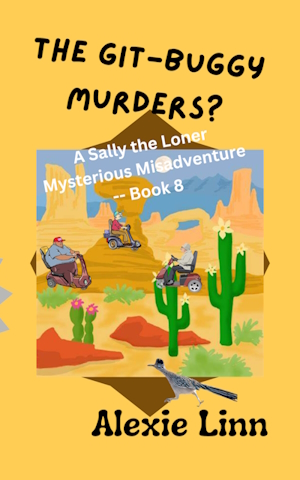
Join Sally on a thrilling adventure as she navigates a mysterious spine-tingling shrieker; missing robots (including Rodney), and a pyromaniac.

With her trusty walking stick in hand, Sally and Cozy Mae embark on their journey. The witty robots, Rodney, Ruth Ann, and Sparkle, are by their side. They must unravel the puzzling clues to save the day.

Will the ladies be reunited with their bots? Can the unlikely team of Sally, Rodney, and Cousin Cozy Mae crack the case of the spine-chilling screech?

Find out in this gripping tale of friendship, mystery, and misadventures.

You might also like…
Join us on:

 Facebook

Goodreads

 Amazon

Bookbub

X

You Tube Channel

Email

How to Corral Flibbertigibbet Characters

How to Corral Flibbertigibbet Characters

Those wild and crazy characters! You know… the Joans, Sallys, Madelines, Rodneys, and more (72+ at last count) that make stories pop.

They were tucked everywhere in manuscripts. I heard them laughing every time I needed them to do their thing in a new tale. I was spending way too much valuable writing time searching for them; their description; and their history.

My needs are simple (most of the time). I simply needed a fast and easy method to call up a character and their history at a moment’s notice.

It’s been a frustrating challenge since the beginning. Yes, there are a glut of cloud-based online offerings like Plottr and Reedsy. But their subscriptions are overkill for my paltry needs. I didn’t need an app to write the story. I just needed to grab a character that had appeared in a previous work.

What a relief when the simple solution pounced right in front of me! What was the lightbulb moment?

Build a simple character database (Index file on the computer) using a feature of my office program. Don’t let the idea scare you. It was fast and easy. And I’m a happy camper for the effort.

Because there is umpteen gazillion office programs out there today… I’ll share with you the outline of how I built the database in Microsoft Access. The names of the tables won’t change; only how you talk to your specific program will.

It’s all about three little tables and their relationships. Here’s the steps:

  1. Create three Tables. Label them: Characters; Books; Series
  2. Hook up the Relationships:
    1. 1 Book to many Characters
    1. 1 Series to many Books
  3. Create a Form to gather information on each character. Duplicate the character’s completed form to add them to another book. Gather as much information as you want but I have used only: Name; Description; Book Title; and Series
    1. Create a Query to automatically gather the characters starring in one book.
    2. Create a Report to produce a Cast of Characters from the query for each book. This report goes to the narrator so she can get acquainted with them before she starts the story. She’s never said ‘eeuw’ so I assume she loves it. I know I do for the next work-in-progress. Ahhhh…

    It’s this simple database that assures continuity in characters – Sally isn’t 87 today and 77 tomorrow. Unless she got in the way of Witch Hazel’s spell that made her 10-years younger instantly.

    Although a cat named Spaghettio may have done just that. The book is called ‘The Tangled Tails of Spaghettio’. And you can read it today for less than a dollar. Read on for the magic link to click.

    Amidst the chaos of Rodney’s hilarious mishaps with his bionic arm and wheelchair, Sally finds herself entangled in a web of bizarre circumstances. With both mankin and cat unleashing havoc, our courageous 87-year-old protagonist must rise to the challenge.

    Can she uncover the truth behind this demented cat and unravel the insanity gripping her world? Will she be able to save Rodney from the clutches of his malfunctioning arm?

    Hold on tight as you dive into this uproarious adventure filled with unexpected twists and turns. Join Sally as she untangles the mysterious cat’s origins and confronts the mysteries that lurk beyond her very own doorstep.

    Prepare yourself for a rollercoaster of laughter, mystery, and heartwarming moments in this charming tale that will keep you eagerly turning the pages.

    But wait!

    You might also like…

    alexielinnauthor.com

    Join us on:

     Facebook

    Goodreads

     Amazon

    Bookbub

    X

    You Tube Channel

    Email

    7 Lessons I Learned from Writing Books

    7 Lessons I Learned from Writing Books

    If I knew then what I know now about writing for readers, would I have taken the leap?

    How do you answer the question, “What don’t you know?”

    With those two questions out of the way, let’s get right to today’s lesson…

    Lesson #1 — I’m Not the One in Control.

    When I took the plunge the picture in my head was akin to being the puppeteer. Me maneuvering and manipulating all the little puppets around the stage to create an entertaining show. The reality is all the little puppets doing their own thing while I wrestle with each one to do it my way. They win. My job and mission is to corral them into a coherent and cohesive story.

    Lesson learned? Myself is all I have control over… most of the time.

    Lesson #2 — Everything takes Time.

    I can outline the story, build the sets, cast the characters, and even write the first draft for a cozy mystery in about two weeks. Then the real work begins…

    The cool downs prior to each of three painstaking edits, the prepping and posting to my website and the distributors.

    Next up is promoting. That never ends. Each new book is like raising a child. They leave, but they’re never gone. And they all require time.

    Lesson learned? Time ticks off, no matter what. Do your best to use it productively.

    Lesson #3 — File for Retrieval

    Do I remember my mindset when I started writing ‘Unexpected Blessings’ nine years ago? Did I file it under Grief Recovery? Or is it in the Joan Freed file? After searching for about an hour, I found it. I’d changed the name on the file the last time I put it away.

    Lesson Learned? File in the protagonist’s folder and never, ever change the name on the file.

    Lesson #4 — Plus One Rules!

    My house runs well on ‘plus-1’ for supplies. When I buy a can of soup, I buy 2. When I slip a quart of engine oil into my cart, I slide in two. And when I need water wipes, I grab an extra for a backup. While I don’t buy two computers when one fails, I learned the hard way to keep a thumb drive in the slot and update it daily for a copy… just in case.

    Lesson learned? Keep one backup copy of every manuscript separate from the computer.

    Lesson #5 — Blessings come in all sounds, sizes, and shapes

    Interruptions usually translate as frustrations. But I have found that whether it be a phone call or a knock on the door, it’s more often a blessing in disguise.

    For instance, the phone call from my long-lost daughter to say she’s coming home. Or the gift of Alaska smoked salmon that is being delivered from my friend in the far north. Or a call from an avid reader looking for the eta on my work in progress.

    Lesson learned? Count the interruptions as blessings. They really are priceless.

    Lesson #6 — Writer’s block has many names

    Brain freeze. Senior moments. Writer’s block. In my case, they are all a temporary frame of mind that comes from stress. Worry of what the next word or paragraph will be that is sure to hook a reader to keep reading. Maybe all the characters are out for recess. They don’t ask me. They just do it and leave me in the lurch. But if I slow down and wait for the characters to return, we’ll be on a roll again.

    Lesson learned? Take a breath. Do something else for a minute while the hooligans I call characters gad about. Like the three little kittens who’ve lost their mittens, they’ll come home with wild stories to tell.

    Lesson #7 — Some say I’m crazy. I’m okay with that.

    I see or feel the eye roll. It happens when I’m getting ready to tuck myself into bed at sundown. And it comes from those who are not morning people.

    Not long ago I had a text waiting for me when I rolled out and booted the computer at 2 AM. I answered it. And got a reply! But the texter was just on his way to bed. Did he feel my eyes roll?

    Lesson learned? We each march to our own drummer. How boring life would be if we didn’t.

    And there you have it. 7 lessons I’ve learned that are directly related to the business of writing.

    What lessons have you learned? Email me here to share.

    But to answer the question of if I knew then what I know now, would I have pursued this career in writing fun, provocative, and interesting books?

    Yes! It’s my way of giving back and encouraging you.

    Cheers!

    You might also like…

    Featured Cozies….

    Join us on:

     Facebook

    Goodreads

     Amazon

    You Tube Channel

    Organized Manuscripts – How to Prevent Writer Frazzle

    Organized Manuscripts – How to Prevent Writer Frazzle

    I don’t know how many books I published before I realized the importance of corralling each work for retrieval. The problem? Disorganized manuscripts were turning me into a frazzled meme.

    But when it comes to filing, I can also over file and make the same frazzled meme out of myself just to maintain the system.

    Neither under-organized nor over-organized filing works! Both systems were gobbling up valuable writing time.

    Finally! I flailed my way to a super simple system for filing each manuscript from moment one of its creation.

    Organized manuscripts are happy manuscripts. And prevent frazzled writer syndrome.

    Here’s how to kick it off:

    Start with a new folder for the new ‘Series’. Next, I open a new folder for each manuscript within the series. Now a specific manuscript within the series is right where I look for it – each and every time.

    The cherry on top? It’s fast and easy to save the day’s work to my back-up thumb drive.

    It’s working great. It will work even better when (?) I go back to the beginning and whip all my manuscripts in line.

    What are the nuts and bolts?

    Here’s the simple process for organized manuscripts.

    It works whether you write on a computer or on paper, but the terminology here is for a computer:

    Start a New Manuscript

    Open a new document. Title it ‘___ Manuscript’. Save it in a new folder (within the ‘Series’ folder) just for this manuscript.

    In this new folder for this manuscript, I save another new document and title it ‘Cast of Characters’. And here’s three more new documents for the book specific folder:

    • Description
    • Narration Version
    • Audition Script

    By inserting the labeled blank documents into the folder at the beginning, I don’t forget to create them while I’m writing the story. Or when I think I’ve finished the book. I’m not finished until the rest of the paperwork is done.

    When it’s time to turn the story into an audiobook, I don’t have a panic attack because I forgot to write the ‘Audition Script’ while all those characters were acting out in my mind.

    If certain places need research detailed, I add it. And pictures, whether they’re avatars or photos. Outlines and research notes go in, too.

    Everything is neat and tidy. And quickly retrievable if I want to change anything or steal from it (I always do!).

    Start Another New Manuscript

    Now, when I get to Book 12 of the series, I simply open the ‘Cast of Characters’ and shop for the carryover characters (or places) from previous organized manuscripts. Then copy and paste to the new work-in-progress ‘Cast of Characters’, etc. document. Easy-peasy. No frustration or frazzle.

    Why did it take me so long to figure this simple system?

    Oh. That’s right. I’m human. Bleh!

    On that note…

    Happy Trails and Tales,

    Alexie Linn

    P.S.  Free Audiobooks……Free Audiobooks……Free Audiobooks…..

    Click here to join our Audible Lovers Cornucopia group. It’s free and where you’ll find links to Free Audibles for your listening and reviewing pleasure.

    The easiest way to get updates is to follow this blog and  follow me on Facebook.  New posts should appear on the Alexie Linn page – if I’ve held my mouth right… 😊

    BUT! If you only want updates and pre-order deals of new releases of Books, Vellas and Audibles, the easiest way is to follow me on Amazon. When you get an email notice of a new book release, simply ask for it by the title – or for all the Alexie Linn authored titles at your favorite retailer.

    Subscribe to my You Tube Channelto not miss a fun and entertaining Book Trailer. They’re short. They’re mesmerizing. And they won’t waste your time.

    And just one more thing. Here’s where to find and follow me on Goodreads. Please do to get in on all that Goodreads has to offer. Goodreads is always at the very best price. It’s FREE!